
 |
| Muller's Velvet Gecko (Homopholis mulleri) a highly restricted and rarely seen gecko from the Soutpansberg. |
As part of our long term greater Soutpansberg Reptile
Survey, the Soutpansberg Centre for Biodiversity and Conservation travelled to
the eastern Soutpansberg to sample the Entabeni area near Thohoyandou. The trip was very
successful; we logged over 400 individual reptiles (284 at Entabeni) with a
total species count of 44, including a new species for our list. Big thanks to
Eric Jolin for all the hard work in the in the field and maintaining a positive
attitude throughout our visit. Also a big thank you to Lorraine Egan from SAFCOL for arranging our accommodation and for permissions.
 |
|
Transvaal Dwarf Chameleon (Bradypodion transvaalense), Entabeni.
|
 |
| Reticulated Centipede Eater (Aparallactus lunulattus) Punda Maria. |
 |
| Painted Reed Frog ( Hyperolius marmoratus taeniatus) Entabeni. |
Entabeni (11-15 February)
 |
| Wet Grassland with forested bush clumps at Entabeni. |
During our stay at Entabeni we aimed to sample as much high
altitude grassland as possible. Finding suitable sites was quite challenging,
as it is not an area we have sampled too many times before. The fragmentation
in the area is quite high, yet there were quite a few pockets of undisturbed
forest and grassland.
We found the grasslands to be quite high in reptile abundance,
most common reptiles being Whalberg’s Snake-eyed Skink (Panaspis whalbergii).
We concentrated our efforts in three main areas. One section of very rocky
grassland that had been quite heavily grazed, another grassland with very few
rocks that was moderately grazed and another patch of grassland which had both
very rocky and less rocky areas which had also been partly grazed and was
partly pristine.
 |
| Flat Dragon Lizard (Smaug depressus) high altitude eastern form. Entabeni. |
 |
| Common Girdled Lizard (Cordylus vittifer). Entabeni. |
 |
| The most frequently seen reptile Wahlberg's Snake-Eyed Skink (Panaspis wahlbergii). Entabeni. |
 |
| Speckled Rock Skink (Trachylepis punctatissima). Entabeni. |
 |
| Variable Skink (Trachylepis varia) a species complex recently split into three. Entabeni. |
 |
| Male Rainbow Skink (Trachylepis margaritifer). Entabeni. |
 |
| Cregoi's Legless Skink (Acontias cregoi). Entabeni. |
 |
| Vanson's Gecko (Pachydactylus vansoni) Entabeni. |
 |
| Soutpansberg Dwarf Gecko (Lygodactylus soutpansbergensis). Entabeni. |
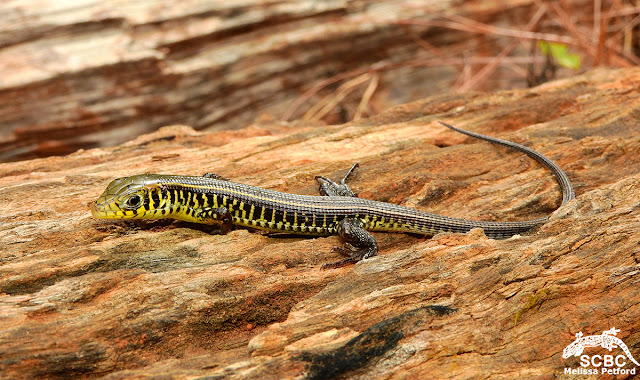 |
| Hatchling Yellow-throated Plated Lizard (Gerrhosaurus flavigularis) found in nursery site with many eggs. Entabeni. |
We made 284 individual reptile observations during our
limited time. Significant records were high altitude records of Short-snouted
Sand Snake (Psammophis brevirostrus),
a predation record for a Natal Green Snake (Philothamnus
natalensis natalensis) which had
eaten two Forest Rain Frogs, Breviceps
sylvestris), a new species for our list a hatchling Rhombic Night Adder
(Causus rhombetus), some Transvaal Dwarf Chameleons (Bradypodion transvaalense) and the twelve species of frogs we
recorded.
 |
| Short-snouted Grass Snake (Psammophis brevirostris) Entabeni. |
 |
|
Hatchling Red-lipped Snake (Crotaphopeltis
hotamboeia) Entabeni.
|
 |
| Hatchling Rhombic Night Adder (Causus rhombeatus), Entabeni. |
 |
| Bicoloured adult Bibron's Blind Snake (Afrotyphlops bibronii). Entabeni. |
 |
|
Natal Sand Frog (Tomopterna natalensis). Entabeni
|
 |
| Flat-Backed Toad (Sclerophrys pusilla). Entabeni |
 |
| Gutteral Toad ( Sclerophrys gutteralis) Entabeni. |
 |
| Common River Frog (Ameita delandii). Entabeni. |
 |
| Soutpansberg Forest Rain Frog (Breviceps sylvestris taeniatus) Entabeni. |
 |
| Bushveld Rain Frog (Breviceps adspersus) Entabeni. |
Punda Maria and Pafuri Sections: Kruger National Park (15-17 February)
 |
| Flat Dragon Lizard (Smaug depressus) Eastern Lowland Form. Punda Maria. |
Leaving Entabeni, the short drive to Punda Maria produced a
few dead on road specimens, including a young
Olive Whip Snake (Psammophis
mossambicus). After driving around looking at megafauna we went back to
camp and walked around in the hot humid weather to see what we could find.
It was rush hour and we photographed many species of frog including a Northern Pygmy
Toad (Poyntonophrynus fenoulheti), Dwarf
Puddle Frog (Phrynobatrachus mababiensis)
and Broad Banded Grass Frog (Ptychadena mossambica). The night also
delivered the highlight for our Punda effort, a beautiful sub-adult Reticulated
Centipede Eater (Aparallactus lunulatus
lunulatus), in addition to this we also found two Stilleto Snakes (Atractaspis bibronii). This has added
another two snake species to our Punda Maria lists.
 |
| Nile crocodile (Crocodylus niloticus). Pafuri. Photo Eric Jolin. |
 |
| Bibron's Stiletto Snake (Atractaspis bibronii) Punda Maria. |
 |
| Turner's Gecko (Chondrodactylus turneri). Punda Maria. |
 |
| Speckled Skink (Pachydactylus punctatus). Punda Maria. |
 |
| Striped Skink (Trachylepis striata) Punda Maria. |
 |
| Giant Plated Lizard (Matobosaurus validus). Punda Maria area. |
 |
| Nile Monitor (Varanus niloticus) Pafuri region. |
During the the drive through Kruger National Park from Punda
Maria to Pafuri we located a few more species for our trip lists. These
included Zimbabwe Flat Lizard (Platysaurus intermedius
rhodesianus), Giant Plated Lizard (Matobosaurus
validus) and a Northern Boomslang (Dispholidus
typus viridis) crossing the road.
 |
|
Dwarf Puddle Frog (Phrynobatrachus mababiensis) Punda Maria.
|
 |
|
Plain Grass Frog (Ptychadena anchieta) Punda Maria.
|
 |
|
Northern Pygmy Toad (Poyntonophrynus fenoulheti) Punda Maria.
|
Pafuri to Lajuma via Waterpoort (17 February)
 |
| Female Muller's Velvet Gecko (Homopholis mulleri) a rarely seen and highly restricted animal. |
To maximise our diversity and areas covered we exited at
Pafuri gate and drove via Waterpoort to to do some night sampling in the area
on our way back home. The trip back produced the highlight of our trip: a male
and female Muller’s Velvet Gecko (Homopholis
mulleri) found at Waterpoort. We also found two juvenile pythons moving
about in moist weather and a very large Rhombic Egg Eater (Dasypeltis scabra).
 |
| Rock Monitor (Varanus albigularis) Pafuri. |
 |
| Southern African Rock Python (Python natalensis). Waterpoort. |
 |
| African Bull Frog ( Pyxicephalus edulis) |
 |
| Melissa Petford with massive Rhombic Egg Eater (Dasypeltis scabra) to show the scale. |
All in all a very succesful trip. Watch this space for more trip reports and contact us if you would like to join us on one of our intensive reptile sampling trips at very resonable prices.
Reptiles (44 Species)
Pelusios sinuatus – Serrated Hinged Terrapin
Stigmochelys pardalis –
Leopard Tortoise
Crocodylus niloticus –
Nile Crocodile
Chondrodactylus
turneri – Turner’s Tubercled Gecko
Hemidactylus mabouia –
Tropical House Gecko
Homopholis mulleri –
Muller’s Velvet Gecko
Homopholis wahlbergii –
Wahlberg’s Velvet Gecko
Lygodactylus ocellatus
soutpansbergensis – Soutpansberg Dwarf Gecko
Pachydactylus
punctatus – Speckled Gecko
Pachydactylus vansoni –
Vanson’s Gecko
Heliolobus lugubris –
Bushveld Lizard
Cordylus vittifer –
Transvaal Girdled Lizard
Smaug warreni
depressus – Flat Girdled Lizard
Platysaurus
intermedius rhodesianus – Zimbabwe Flat Lizard
Broadleysaurus major –
Rough-scaled Plated Lizard
Gerrhosaurus
flavigularis – Yellow Throated Plated Lizard
Matobosaurus validus –
Giant Plated Lizard
Acontias cregoi –
Cregoi’s Legless Skink
Panaspis maculicollis –
Spotted-necked Snake-eyed Skink
Panaspis wahlbergii –
Wahlberg’s Snake-eyed Skink
Mochlus sundevallii
sundevallii – Sundevall’s Writhing Skink
Trachylepis
margaritifer – Rainbow Skink
Trachylepis
punctatissima – Speckled Rock Skink
Trachylepis striata –
Striped Skink
Trachylepis varia –
Variable Skink
Varanus albigularis
albigularis – Rock Monitor
Varanus niloticus –
Water Monitor
Chamaeleo dilepis
dilepis – Flap-necked Chameleon
Bradypodion
transvaalense – Wolkberg Dwarf Chameleon
Acanthocercus
atricollis atricollis – Southern Tree Agama
Afrotyphlops bibronii –
Bibron’s Blind Snake
Leptotyphlops sp. –
Unidentified Worm Snake
Python natalensis –
Southern African Python
Bitis arietans
arietans – Puff Adder
Causus rhombeatus
– Rhombic Night Adder
Aparallactus lunulatus
lunulatus – Reticulated Centipede Eater
Atractaspis bibronii –
Bibron’s Stiletto Snake
Psammophis
brevirostris – Short-snouted Grass Snake
Psammophis mossambicus
– Olive Grass Snake
Elapsoidea sundevallii
longicauda – Long-tailed Garter Snake
Dasypeltis scabra –
Rhombic Egg Eater
Dispholidus typus –
Northern Boomslang
Crotaphopeltis
hotamboeia – Red-lipped Snake
Philothamnus
natalensis natalensis – Eastern Natal Green Snake
Amphibians (20
species)
Breviceps adspersus adspersus – Bushveld
Rain Frog
Breviceps sylvestris taeniatus – Soutpansberg
Forest Rain Frog
Poyntonophrynus fenoulheti – Northern
Pygmy Toad
Schismaderma carens – Red Toad
Sclerophrys capensis – Raucous Toad
Sclerophrys garmani – Eastern Olive Toad
Sclerophrys gutteralis – Guttural Toad
Sclerophrys pusilla – Flat-Backed Toad
Hyperolius marmoratus taeniatus – Painted
Reed Frog
Kassina senegalensis – Bubbling Kassina
Phrynomantis bifasciatus – Banded Rubber
Frog
Phrynobatrachus mababiensis – Dwarf
Puddle Frog
Ptychadena anchieta – Plain Grass Frog
Ptychadena mossambica – Broad Banded Grass
Frog
Xenopus laevis – Common Platanna
Ametia delandii – Common River Frog
Cacosternum boettgeri – Boettger's Caco
Pyxicephalus edulis – African Bullfrog
Strongylopus grayii – Clicking Stream
Frog
Tomopterna
natalensis – Natal Sand Frog
Chiromantis xerampelina – Southern Foam
Nest Frog
 |
| Southern Ground Hornbill. Also interested in herps. |


